
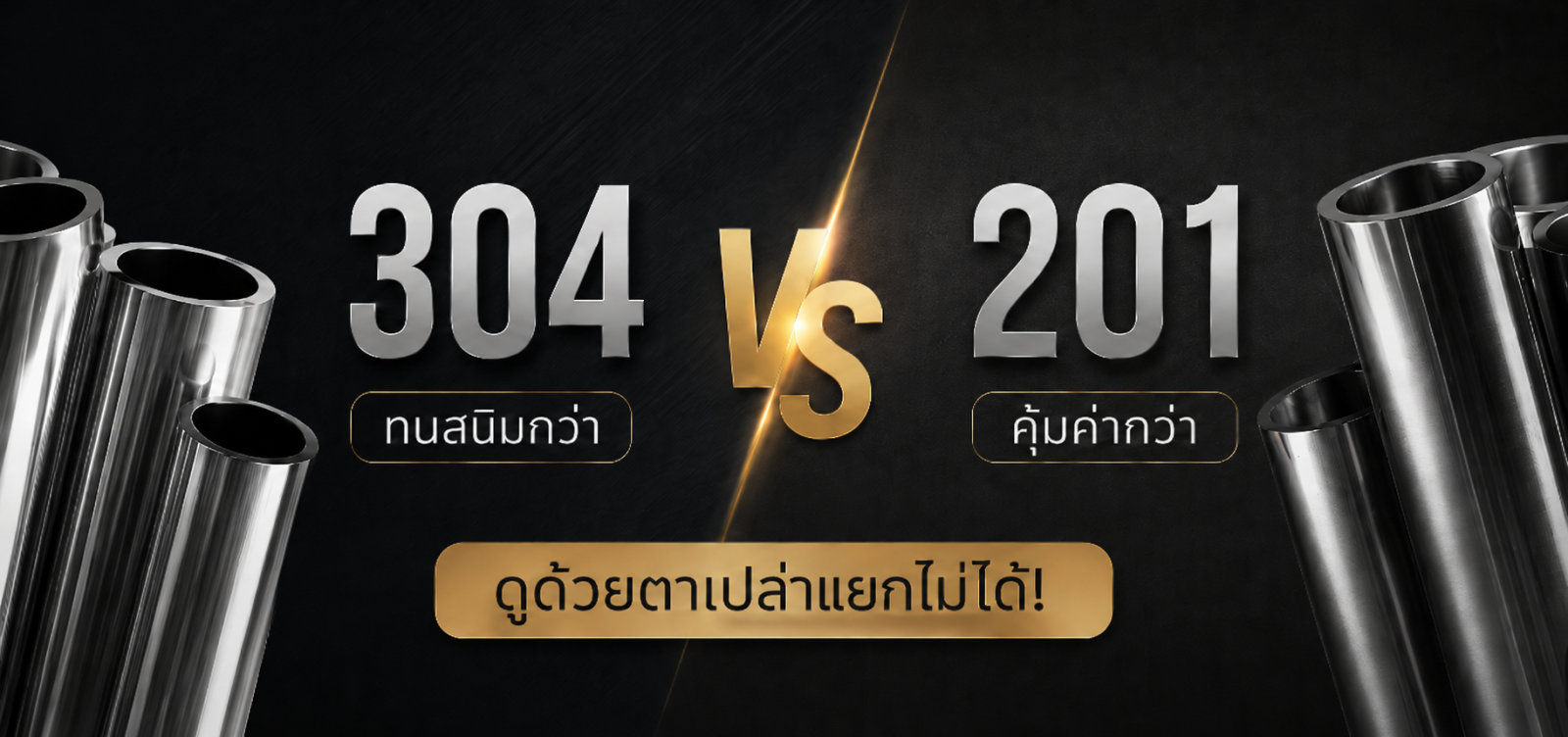
When choosing stainless steel stanchions, you may often come across two common material specifications:
Stainless Steel 201
and
Stainless Steel 304
So which one is better?
The answer is not as simple as choosing one grade over the other.
Both 201 and 304 stainless steel have their own advantages, limitations, costs, and suitable applications. What matters most is understanding what material you are buying, whether it is suitable for your environment, and whether the product you receive actually matches the grade you paid for.
Both 201 and 304 belong to the austenitic stainless steel family, but their chemical compositions are different.
One of the major differences is the amount of nickel and manganese used in the alloy.
304 stainless steel generally contains a higher proportion of nickel, while 201 contains less nickel and uses more manganese as part of its alloy composition.
This difference affects several characteristics, including corrosion resistance, cost, mechanical properties, and suitability for different environments.
Stainless Steel 201 can be a practical and cost-effective material for many applications.
Its key advantages include:
For products such as crowd control stanchions used primarily indoors, 201 can be a perfectly reasonable material when selected for the right environment.
Compared with 304, Stainless Steel 201 generally offers lower corrosion resistance.
It may therefore require greater care when used in environments involving:
This does not mean 201 is a poor-quality material.
It simply means that its characteristics need to match the intended application.
Stainless Steel 304 is one of the most widely used stainless-steel grades.
Its advantages generally include:
For installations exposed to higher humidity or more demanding conditions, 304 may offer additional advantages.
The main trade-off is cost.
Because of its alloy composition, 304 stainless steel usually has a higher material cost than 201, which often results in a higher finished-product price.
That extra cost can be worthwhile when the application requires it.
But it does not necessarily mean every stanchion or every installation needs to be made from 304.
This is one of the most important things buyers should understand.
In many cases, no.
After polishing and finishing, Stainless Steel 201 and Stainless Steel 304 can look extremely similar.
Both can appear:
For most customers, it is extremely difficult to determine the stainless-steel grade simply by looking at the finished product.
That creates an important purchasing risk.
A product listing may state that the material is “Stainless Steel 304,” but the appearance of the finished product alone cannot confirm that the material is actually 304.
This is why buyers should not assume that a shiny or premium-looking stainless-steel surface automatically means it is Grade 304.
The real issue is not whether 201 is “good” and 304 is “better.”
The issue is whether the customer receives the same material specification that was advertised and paid for.
For example:
If a customer chooses 201 and receives 201, the material specification is clear.
If a customer pays for 304, the product should also be made from the specified 304 material.
Because the two grades can look very similar after polishing, incorrect material claims can be difficult for customers to identify visually.
This is why understanding basic verification methods can be useful, especially when purchasing large quantities or when material specifications are important to the project.
There are several methods, ranging from simple preliminary testing to professional material analysis.
One of the more accessible methods is using a stainless steel grade test solution designed to help distinguish between different grades.
The general process is:
The reaction can provide an indication of the stainless-steel grade.
However, there is one important point:
Different test solutions may use different chemicals, reaction times and colour charts.
Therefore, do not assume that one particular colour always means 201 or 304.
Always follow the instructions supplied with the specific testing product.
Chemical spot testing is best considered a preliminary verification method, rather than the highest level of material certification.
When more reliable material identification is required, professional equipment can be used.
One common method is XRF — X-ray Fluorescence analysis.
XRF equipment can analyse the elemental composition of a metal and help identify whether the material corresponds to a particular stainless-steel grade.
This type of testing is often used as part of Positive Material Identification — PMI.
It can be particularly useful when:
Instead of judging the product from its appearance, the equipment analyses the material itself.
A magnet test is often discussed online, but it should not be used as the only method for identifying 201 versus 304 stainless steel.
The magnetic behaviour of stainless steel can be affected by several factors, including manufacturing and cold-working processes.
A piece of stainless steel may therefore show some magnetic response even when its grade would normally be considered largely non-magnetic.
A magnet may provide additional information, but it should not be treated as definitive proof that a product is or is not Grade 304.
No.
That is an oversimplification.
Different stainless-steel grades exist because different applications have different requirements.
A crowd control stanchion used indoors in an air-conditioned shopping mall does not necessarily face the same environment as a stanchion regularly exposed to moisture or outdoor conditions.
Selecting the most expensive material is therefore not automatically the same as selecting the most appropriate material.
The better question is:
“Which material is suitable for the way this product will actually be used?”
That decision should consider factors such as:
For buyers, this may be more important than deciding whether 201 or 304 is universally better.
If a product is sold as Stainless Steel 201, it should be 201.
If a product is sold and priced as Stainless Steel 304, customers should reasonably expect the supplied material to correspond to that specification.
Because visual appearance alone is not a reliable method of identifying the grade, buyers may wish to ask the supplier about:
A very low price for a product advertised as Grade 304 may also be a reasonable reason to ask more questions before purchasing.
At Polar Premium, we do not believe every customer needs Stainless Steel 304.
We also do not believe Stainless Steel 201 is suitable for every application.
Different environments, budgets and operational requirements call for different solutions.
That is why selected Polar Premium stanchions are available with different material specifications, allowing customers to choose according to their actual requirements.
Our role is not simply to recommend the most expensive option.
Our role is to help customers understand:
What they are buying.
Why they are choosing it.
And whether it is suitable for the way they intend to use it.
Because to us, Premium does not simply mean choosing the highest-priced material.
It means providing the right product, accurate information, and a solution that genuinely fits the application.
Stainless Steel 201 and Stainless Steel 304 both have advantages and limitations.
201 can provide excellent value and good performance for suitable applications, while 304 generally offers greater resistance to corrosion and demanding environments.
However, perhaps the most important thing for customers to understand is this:
You usually cannot confirm whether polished stainless steel is 201 or 304 simply by looking at it.
Basic stainless-steel test solutions can provide an initial indication, while professional methods such as XRF or PMI can provide more reliable material verification.
So instead of asking only:
“Is 304 better than 201?”
A more useful question may be:
“Which grade is suitable for my application — and am I receiving the same grade that I am paying for?”
Polar Premium — Better decisions begin with clear, honest information.